
MANGAN LAW
Court-Martial Appeals Lawyer
Your Service Deserves the Best Defense
Criminal Investigations
Administrative Investigations
Military Medical Privileging/Credentialing
Adverse Administrative Actions
Court-Martial Representation
At Mangan Law, we understand a fundamental truth that many overlook: a trial conviction is not necessarily the final word. While the trial may feel like the end, the military justice system is built with a robust, multi-tiered appellate structure specifically designed to identify and correct legal errors, factual insufficiencies, and sentence inequities. We offer the high-level expertise required to dismantle a conviction and fight for your freedom.
Can You Appeal a Court-Martial Conviction?
Yes. A court-martial conviction is not an automatic finality. The military system includes a mandatory appellate review for most serious offenses. This provides a critical “second look” at the proceedings to ensure your rights were protected. At Mangan Law, we leverage 30+ years of experience—including Sean Mangan’s unique tenure as a Military Trial Judge and Paul Judge’s time at the Court of Appeals and the Armed Forces and Virginia Supreme Court—to identify trial-level flaws that less experienced counsel often miss.
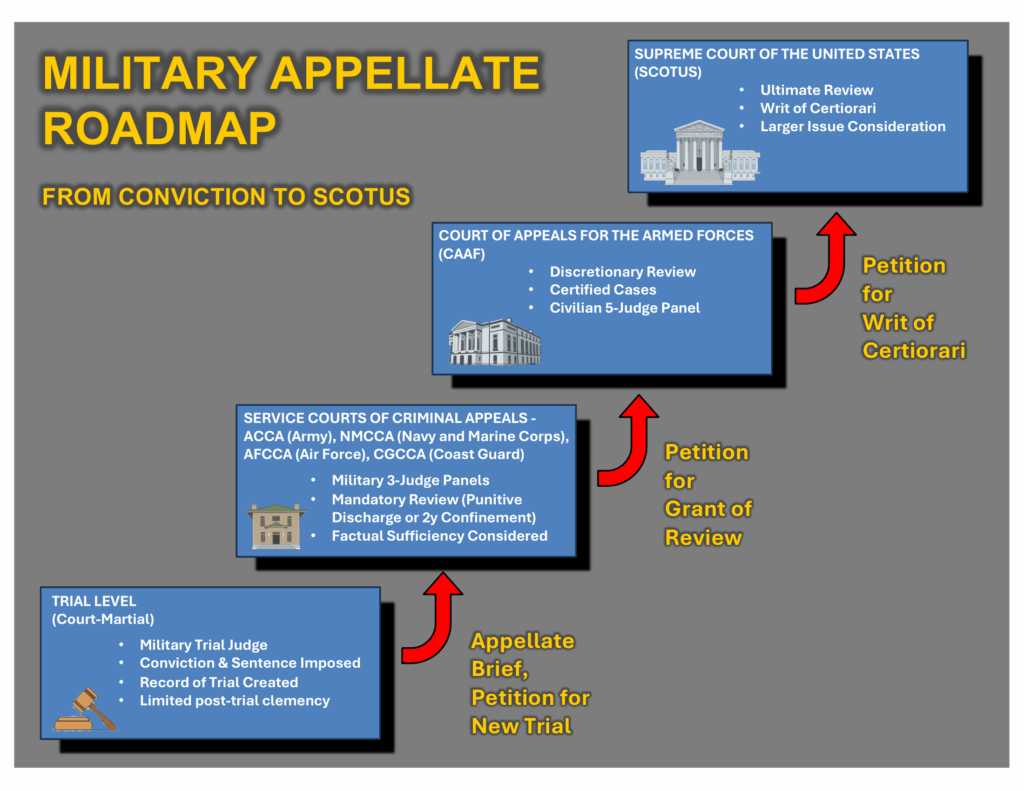
The Three Tiers of Military Appellate Review
The appellate roadmap ensures multiple layers of oversight to prevent injustice:
- Service Courts of Criminal Appeals (CCA): Courts such as the ACCA, NMCCA, AFCCA, and CGCCA perform mandatory reviews for cases involving death, officer dismissal, dishonorable/bad-conduct discharges, or confinement of two years or more.
- Court of Appeals for the Armed Forces (CAAF): A civilian-led “supreme court” for the military that reviews cases on a discretionary “good cause” basis or when certified by a Judge Advocate General.
- Supreme Court of the United States: The final tier, which may review CAAF decisions via a writ of certiorari.
Common Grounds for a Military Appeal
Appeals are not a “do-over” of the trial; they are focused on identifying material errors of law. Every trial has its issues, but not every issue makes for a winning appeal. It takes a knowledgeable, seasoned appellate counsel to know the difference. We scrutinize the Record of Trial for things that matter.
- Substantive Legal Errors: Misinterpretations of the UCMJ or incorrect evidentiary rulings by the trial judge that create sufficient impact that requires an appellate court to take corrective action.
- Unlawful Command Influence (UCI): Instances where senior leadership improperly interfered with the trial or the jury is a unique element that sets military courts-martial apart from civilian criminal cases.
- Ineffective Assistance of Counsel: While the law gives latitude for mistakes, certain errors by the defense counsel at trial may rise to a level warranting relief. If your trial attorney made this kind of gross error failed to meet professional standards, it may have prejudiced the outcome of your case, warranting relief on appeal.
- Factual Sufficiency: Unique to appellate review Article 66’s broad mandate to service courts of criminal appeals: to re-look the facts of the case to ensure they support the conviction. This allows attorneys appealing courts-martial to challenge your conviction by arguing that the evidence presented by the prosecution failed to meet the mandatory “beyond a reasonable doubt” standard.
Why Choose Mangan Law for Your Appeal?
The government provides free appellate counsel, but these attorneys often manage heavy caseloads and may lack the specialized trial judge perspective needed to spot subtle “fault lines” in a trial record.
- Seasoned and Uniquely Qualified: Before serving as a Military Trial Judge, Sean Mangan handled appeals as an appellate attorney and as a Branch Chief at the Army’s Defense Appellate Division (DAD). He was later hand-picked by the Judge Advocate General to handle a conflict cases.
- Elite Clerkship Experience: Paul Judge clerked at the Court of Appeals for the Armed Forces (CAAF) under the Honorable Judge Ryan and later worked at the Supreme Court of Virginia.
- Candid, Independent Review: We provide a “fresh set of eyes” on the entire record, from pretrial motions to final instructions. If our analysis reveals no potential for success, we will tell you directly, allowing you to proceed with free government representation instead.
- Comprehensive Narrative Strategy: We don’t just write briefs; we build a narrative designed to persuade appellate judges that an injustice occurred.
If you have been convicted at a contested court-martial, contact us today for a confidential legal consultation.
Frequently Asked Questions
- How long does a military court-martial appeal take? The timeline varies by branch and complexity, but a mandatory review at the Court of Criminal Appeals (CCA) typically takes 12 to 24 months from the date the record is transcribed. If the case proceeds to the CAAF, expect an additional 6 to 12 months.
- Can I be released from confinement while my appeal is pending? While possible, “Deferment of Confinement” is rarely granted. However, a successful appeal can lead to a “set aside” of the findings and sentence, potentially resulting in your immediate release or a new trial.
- What happens if my conviction is overturned? If an appellate court finds a material error of law or factual insufficiency, they can “set aside” the conviction. The government then decides whether to dismiss the charges entirely or attempt to retry the case at a new court-martial.
- Do I have to pay for a civilian appellate attorney? The military provides free appellate counsel, but you have the right to hire an independent civilian attorney. Many choose Mangan Law because our independent scrutiny and former judge’s perspective allow us to identify subtle errors that high-volume government offices may overlook.
- Can the appellate court increase my sentence? No. Under the UCMJ, an appellate court can affirm the sentence, decrease it, or set it aside, but they cannot increase the punishment originally imposed at trial.
A court-martial conviction may feel like the end, but the appellate process is your critical second chance to secure justice. At Mangan Law, we apply a “Judge’s Lens” to scrutinize every page of your trial record for legal errors and factual insufficiencies that others miss. Don’t leave your freedom and future to chance; put an elite team of former judges and appellate clerks to work on your defense. Call Call Mangan Law today at (360) 908-2203 or schedule your confidential consultation online.
We Serve Where You Serve
Joint Base Lewis-McChord | Joint Base Elmendorf-Richardson | Fort Wainwright | Naval Base Kitsap | Joint Base San-Antonio | Fairchild AFB | Mountain Home AFB | Malmstrom AFB | USCG Kodiak | Fort Huachuca | Fort Irwin | Ellsworth AFB | FE Warren AFB | Fort Leavenworth | Fort Johnson | Fort Eisenhower | Hill AFB | Beale AFB | Minot AFB | Grand Forks AFB | Fort Liberty | Fort Cavazos | Fort Riley | Fort Stewart | Fort Moore | USCG Sector Puget Sound | Fort Carson, Peterson SFB, Air Force Academy | Wright-Patterson AFB | Military District of Washington
Mangan Law
The Law Offices of Sean F. Mangan, PLLC
Proactive intervention early to favorably resolve cases without litigation or formal action
Aggressive and advanced pretrial and trial litigation tactics
Master Military Justice Practitioner
Unmatched diversity of experience, having handled criminal cases from every angle
Respected
standing with all military services
I am ready to fight for you!
SCHEDULE CONSULTATION nowINVESTIGATOR
PROSECUTOR
MAGISTRATE
DEFENSE COUNSEL
APPELLATE COUNSEL
TRIAL JUDGE
INVESTIGATOR
PROSECUTOR
MAGISTRATE
DEFENSE COUNSEL
APPELLATE COUNSEL
TRIAL JUDGE